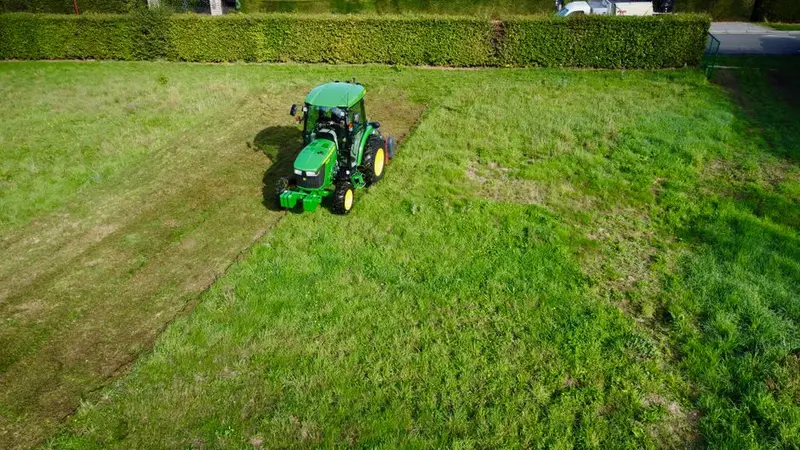
What a full-service contract covers
Full-service commercial maintenance typically runs $800–$1,600 per acre per month, or about $0.10–$0.30 per square foot per month, equalized into twelve payments. That rate bundles the recurring work below; enhancements, irrigation repairs and snow are priced separately.
| Line item | Field standard | Frequency |
|---|---|---|
| Mowing | 2.5–3.5 in. cut height by cultivar; never remove more than 1/3 of blade height; alternate patterns weekly | 28 visits (northern) · 32 (transition) · 36–42 (southern / year-round) |
| String trimming & edging | Mechanical edging of curbs, walks and bed lines; trim around obstacles, fences, signs and utility boxes | Edging every mow or every other mow; beds monthly |
| Blowing & litter | Blow clippings off hard surfaces into turf, never into storm drains; pick up litter before mowing | Every visit |
| Bed care | Hand/chemical weed control; refresh mulch to a 2–3 in. settled depth, kept off trunks and stems | Weeding every 2–3 weeks in season; mulch annually |
| Turf agronomics | 4–6 fertilization and weed-control rounds; fall core aeration and overseeding on cool-season turf | Per program |
| Shrub pruning | Natural-form or architectural pruning; hand-pruning on flowering shrubs at the right bloom window | 2x–4x per year |
| Cleanups | Spring cleanup and fall leaf removal; storm debris on call | 2–4 per year |
| Reporting | Digital visit slips with photos; scheduled account-manager walkthroughs | Each visit / monthly or quarterly |
Mulch: depth, volume and the no-volcano clause
Mulch is the line most often under-scoped in a low bid. Spec a fresh depth of 2–3 inches and require the contractor to state the cubic yards they will install.
Cubic yards = (bed area in sq ft × depth in inches) ÷ 324
| Bed area | 2 in. depth | 3 in. depth |
|---|---|---|
| 1,000 sq ft | 6.2 yd³ | 9.3 yd³ |
| 5,000 sq ft | 30.9 yd³ | 46.3 yd³ |
| 10,000 sq ft | 61.7 yd³ | 92.6 yd³ |
| 25,000 sq ft | 154.3 yd³ | 231.5 yd³ |
Contract clause to copy: “Mulch shall be installed to a settled depth of 2–3 inches. Mulch shall be pulled back 3–6 inches from tree trunks and shrub stems; volcano mulching against trunks is not acceptable.”
Turf agronomics programs
- Mowing & edging only: lowest cost; turf color and density depend on weather and existing fertility.
- Standard 4-round program: early spring pre-emergent plus fertilizer, late spring broadleaf control, summer slow-release, fall feeding.
- Full 6-round program with fall core aeration and overseeding: the standard for high-visibility HOA entries and corporate campuses with cool-season turf.
Labor and productivity context (NALP)
Industry financial benchmarks published by the National Association of Landscape Professionals put average revenue per employee around $123,000 across the industry and about $156,000 in commercial maintenance, with route-dense top-quartile operators at $180,000–$220,000+. Direct field labor in a well-run commercial maintenance company consumes roughly 30%–35% of revenue (35%–50% fully loaded), with a 45%–55% gross-margin target.
For a buyer, that means a bid far below market usually removes visits, mulch yardage or supervision rather than finding efficiency. The RFP checklist shows how to spot it.
What to put in your RFP
- Annual visit count by month, not just “weekly in season”
- Cut height range and the 1/3 rule
- Bed square footage and the cubic yards of mulch to be installed
- Pruning cycles and the standard (natural form, ANSI A300 for trees)
- Irrigation: what monitoring is included and where time-and-materials repair begins
- Visit documentation and walkthrough cadence
- Certificate of insurance: general liability, auto and workers’ compensation
Model this scope in the Commercial Estimator